ΑΡΠΕΛ
by Collectif MASI (Madlen Anipsitaki & Simon Riedler)
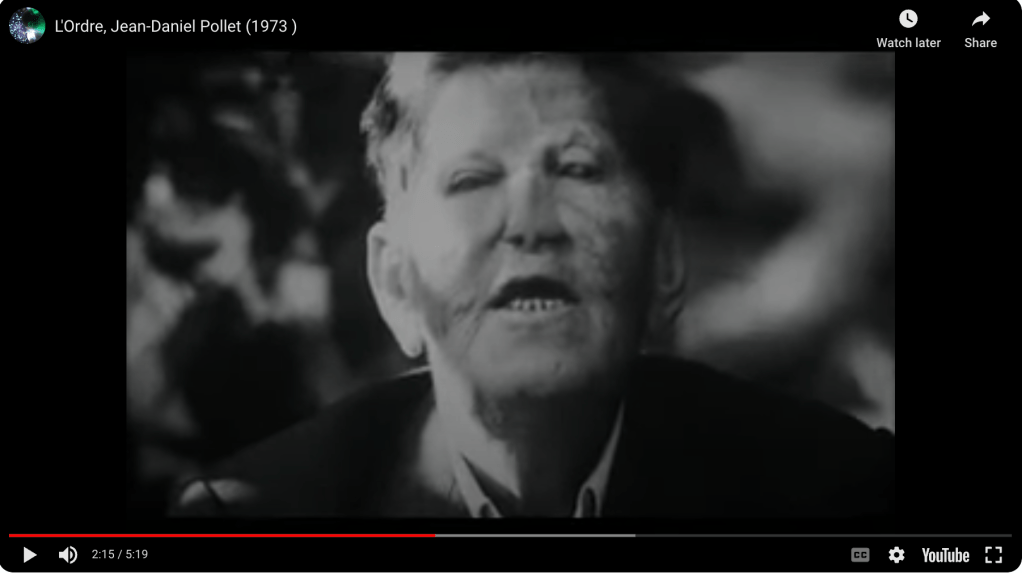
« You will soon pack up your machines and leave. But we’ll stay here. Perhaps you will feel sadness growing in you. You pity us for the disease. But I think it’s us who should be sorry for you. For if, a fence, a wall separates us from the jungle of life, yet we have found the goal and purpose of life here in the furnace of sickness and isolation. »
Epaminondas Remoundakis, interviewed by Maurice Born and Jean-Daniel Pollet in “The Order” (1973)
ΑΡΠΕΛ focuses on the islet of Spinalonga, a contemporary cretan touristic attraction which, in the period 1903 – 1957 was used as a leper colony. The “care” can be split in two dimensions, the treatment (medical or spiritual, individual) and the solidarity (interdependence and mutual aid, collective). Spinalonga is the paradigm of the solidarity in the adversity, hence reversing the stigma on the « LEPRA » which becomes « ARPEL ».
STATE OF PLAY : SOLIDARITY AMONG LOCKDOWNS
At only 12km of Agios Nikolaos (Crete) and 800m from the village of Plaka, Spinalonga is a narrow rocky islet that closes the bay of Elounda from the north. Its socio-politic history is one of successive occupations. The Venetian, from 1549 to 1715, who built its remarkable fortification in the late 16th century to counter the expected siege of Venetian-occupied Crete by the Ottomans, who eventually ruled it from 1715 to 1897, then the French from 1897 to 1899. It became Greek and in order to force the last Turkish inhabitants to leave it was used as a place of lepers’ isolation from 1903 to 1957, becoming the today’s famous « Island of the living dead ».
Moreover, the lepers developed among themselves an exemplary system of mutual aid and care: if one lacked hands, the community would be one’s hands, if one lacked eyes, the community would be one’s eyes. This is how they managed not only to survive, but to achieve an alternative to individualistic and competitive societies. Maurice Born, social researcher, develops this idea in the end of his book « Lives and deaths of a Cretan leper » (2015) after almost 50 years of working on Spinalonga. This book is based on his interviews with Epaminondas Remoundakis.
E. Remoundakis was the leading figure of the leper community. While being a third-year law student in Athens hiding his disease, he was imprisoned on the island in 1936 and stayed until the end of the leper colony. He founded the « Brotherhood of Patients of Spinalonga » and the community started fighting for their rights. The progress started with a barque and led to an electric generator to light the streets at night.
The lepers’ fight against exclusion and darkness inspires us today, who have just lived the crushing experience of the lockdown. The Covid19 highlighted the inequality that reigns on our planet, but also the imbalance brought about by the absence of care worldwide. We believe that the leper society in Spinalonga can somehow become a model for a global system of care. During our time of lockdown, we saw how much the health systems, the care systems in general, are suffering. Spinalonga can inspire the upgrading of care with an approach that does not limit it to the individual and family level, but highlights its social and political necessity.
ARTISTIC GESTURE : ΑΡΠΕΛ IS AN ALLEGORY OF CARE
Our artistic gesture is to create an allegory of the concept of care behind an alternative history where the people of today meet the lepers of yesterday through an immersive painting and an interactive installation. The title ΑΡΠΕΛ is an inversion of the word ΛΕΠΡΑ, leprosy in greek, which aspires to be not only a verbal, but also a substantial, conceptual inversion of the stigma, an honour to the memory of the lepers. At stake lies the immaterial patrimony of Spinalonga and the way to carefully treat it.
So, we base our work on real events, architecture and characters but also use symbols and double-meanings to express ΑΡΠΕΛ below the story of Spinalonga. Solidarity, mutual aid on one side and medical and spiritual treatment on the other side need to meet.
This encounter between the two sides of the care challenges us to offer two ways of apprehending the artwork. The blue of the sea-sky gives the visual continuity, Spinalonga gives the unity of place. The visitor walking and the protagonists of the scenes are giving movement. They are hybridising and this gives colours to the palette, which gets lighter as we follow the ΑΡΠΕΛ path.
ΑΡΠΕΛ has five letters, we assign a letter to each drawing. On each drawing, except the one representing the lockdown in Spinalonga, at least one bird leads the visitor to emancipation away from mental and physical lockdown.
NB :
The two following paths are intertwined with other layers of interpretations, among them the biblical one regarding the leper as God’s punishment and the christian redemption through helping the lepers. The Church did play a great role in the improvement of the leper colony. But our artwork and this description avoids any religious imposition, leaving this interpretation entirely open to one’s conscience and beliefs.
ANALYTIC DESCRIPTION
ΑΡΠΕΛ
On one way we read AΡΠΕΛ. The visitor walks in the footsteps of the lepers, making themselves free from the stigma and eventually the earth becomes an archipel of emancipated “Spinalongas”
A
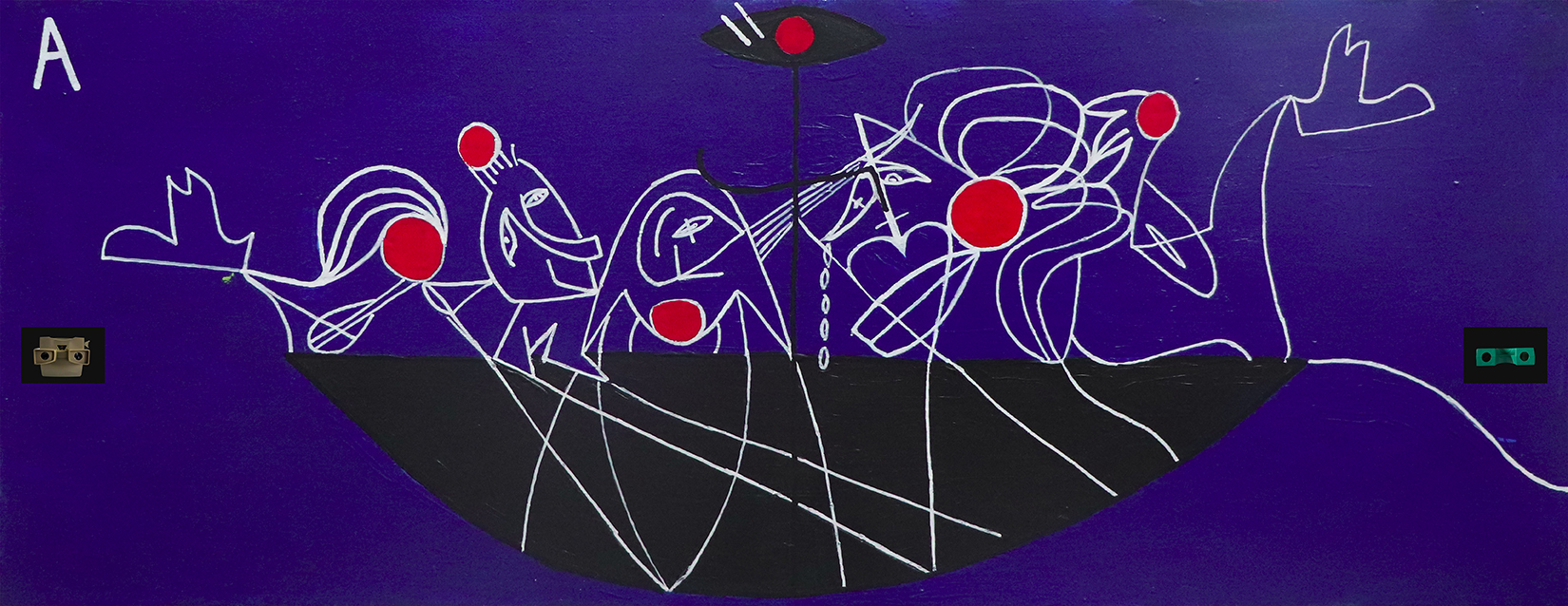
Picture in the « view master » from « Crete without gods« , R. Leenhardt & R. Zuber (1935) – see end of the page
The lepers’ Boat-Anchor leading the newcomers to the leper colony.
6 (the number of harmony in numerology) characters are suspended in time, erased from the civil register, afraid of what’s expecting them. They are stamped by the stigma represented as a red circle, the leper’s mark that often lead to the diagnosis of the leprosy.
We are inspired on real characters.
In the middle, stable in his boots, Epaminondas Remoundakis.
On the left, playing the song of despair, the well-known lyricist of Spinalonga who was the last to leave the island according to Werner Herzog docu-fiction “Last words” (1967, see end of the page)
Between them stands a “doomed” kid.
On the right of E. Remoundakis is a couple. Based on a real story, the woman cut her arm and rubbed it to her husband in order to be contaminated and allowed to join him in Spinalonga
On the far right, a generous leper.
The two birds, symbols of freedom, are leaving from the boat.
Ρ
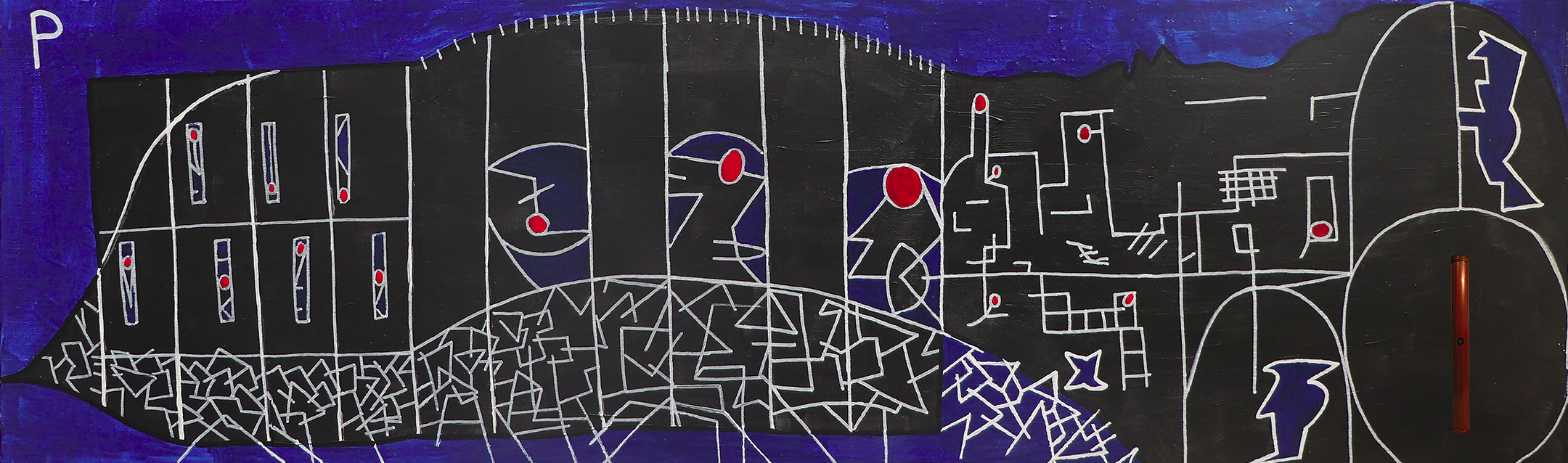
Picture in the « view master » from « Crete without gods », R. Leenhardt & R. Zuber (1935) – see end of the page
The lepers discover the ominous Spinalonga. They are watched by mysterious presences through the battlements. On the bottom right, the “Dante’s Gate” of Spinalonga, as the lepers called it, meaning the gate of hell and enjoining to “Abandon all hope”.
Π
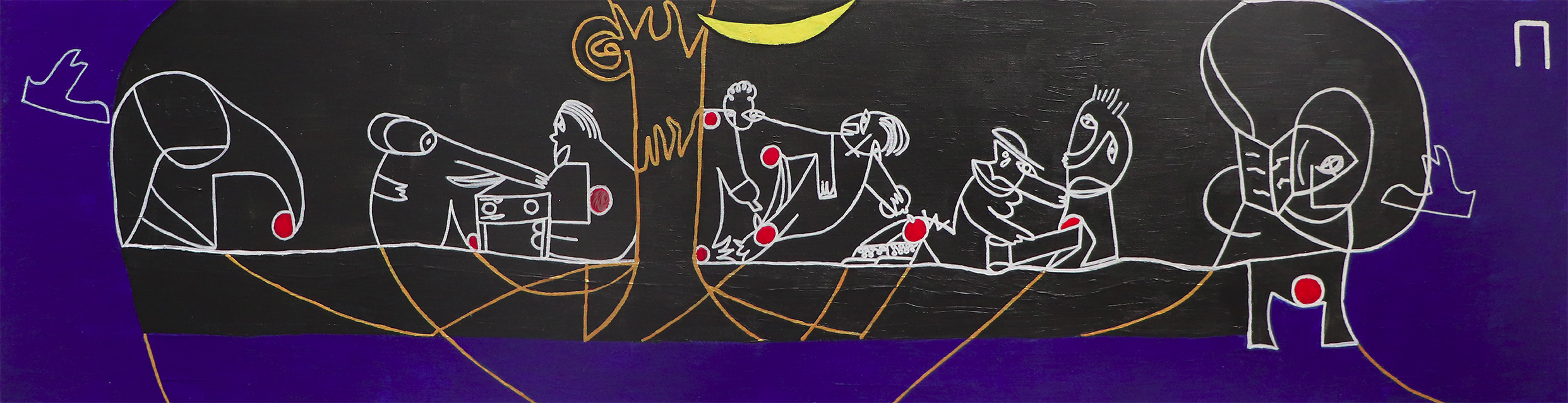
Picture in the « view master » from « Crete without gods« , R. Leenhardt & R. Zuber (1935) – see end of the page
The bird is coming back so does hope.
One character on the left transitions from despair to care, accepting his stigma (another important step to reverse it, from inside). Scenes from the everyday life of the lepers in Spinalonga are depicted here, showing the care that they provide to each other and the solidarity that characterises their society.
So the lines extending them from above are uniting, like the roots of a tree-totem-column trying to reach the moon.
On the right is E. Remoundakis opening the book of the possibilities and the door to the dream.
Ε

Picture in the « view master » : Portrait of Epaminondas Remoundakis
The encounter and hybridation between lepers and “healthy” people from the other bank. Like says Jean-Pierre Vernant in “Crossing borders” (2004, we translate) :
“Between the banks of sameness and otherness, man is a bridge”
Carried by E. Remoundakis charisma (previous painting), by a Boat-Mermaid and a Boat-Dancer, the lepers fictively leave Spinalonga as they knew it and emancipate from the stigma.
They encounter the kids that they were godfathers of, a teacher, a doctor and a sailor.
Both banks hybridise through symbols, dance and a ceremony of Care with on the left the solidarity/leprous side and on the right the treatment/doctor’s side. The lepers are cured both from the disease and the stigma (no more red circles). They become a model of mutual aid. We also hybridize shapes, colours and symbols, for example the circle became joyfully yellow, like the moon of the previous wall.
As we progress after the pedestal lies a golden shape of two feet-hands-fins crossing welcoming the passengers of a Boat-bridge between the coast and Spinalonga. This could be a statue the lepers built on their island.
The characters stuck in the windows on the 2nd wall are jumping out of them to welcome the newcomers.
The newcomers have red faces, because red is not only the colour of the plea but also the one of solidarity, warmth and love.
Λ
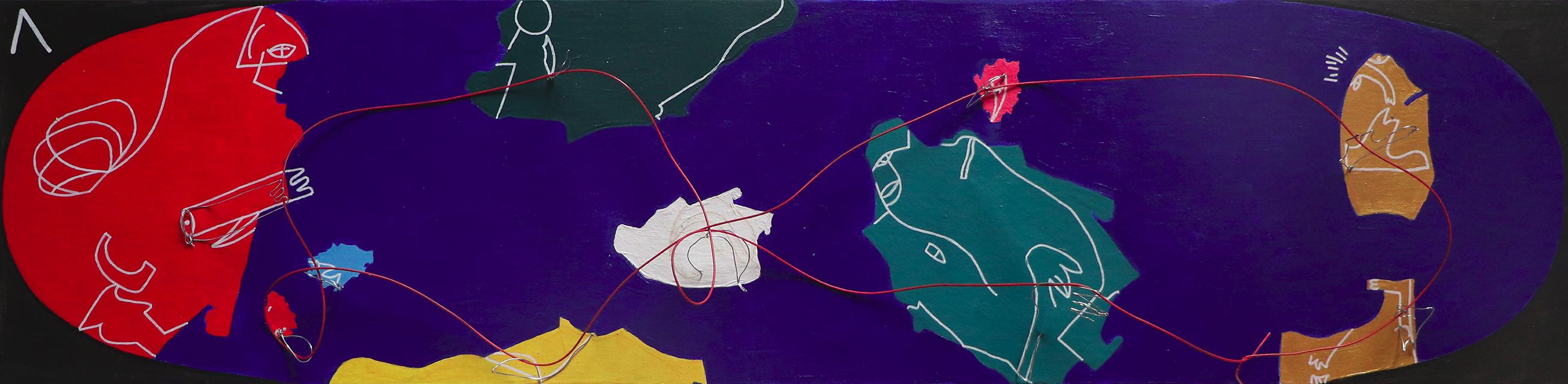
Picture in the « view master » : Aerial view of Spinalonga ©Ephoria of Lassithi Antiquities
The planisphere as an archipel of “Spinalongas”. The collective apprehension of care carried by the lepers in Spinalonga spread out to the whole world.
The marks of the lepers’ bodies are incrusted in the islands, materialising their immaterial legacy to earth. Fragments of various characters are in volume and united with threads so that the visitor kind of shakes hands with them by following the thread. This common material (central in our general work) displays connections rather than the isolation or confinement, both of the lepers on Spinalonga, but also of any of us.
Only one iconic building of the fortress, which shape is a hemicycle, is represented, it might have become a parliament or a theatre.
The borders of « Spinalongas” are different because of variations on the fortifications. The island itself is emancipating from the lockdown and stigma. So the bird eventually lands in it.
ΛΕΠΡΑ
The reverse path is ΛΕΠΡΑ and opens to an alternative narrative. It is now the “healthy” visitor’s point of view, a potential visitor of contemporary Spinalonga. We assume that one experiencing today a tour of “The island of the living dead” isn’t the same once setting foot on the ruins of the fortification intertwined with the “ghosts” of the lepers.
Λ
Earth is an archipel of free “Spinalongas”, where the memory of the lepers is honoured and incrusted. They didn’t and don’t have “Λεπρα” as a disease but they have “Αρπελ” as a paradigm of mutual aid.
E
Following the “healthy” visitor’s point of view, we travel in time to the moment where for the first time since 1903 “healthy” people bear foot on the leper colony of Spinalonga. They are joyfully welcomed by the arpelers and hybridise with the local community through symbols and dance. We use the old fantasy of the strong contagion of the leprosy to alter Nikos Kazantzakis quote about Crete and project it on Spinalonga :
« The mystery of Crete Spinalonga is profound – whoever steps on this island feels mysterious power, warm, loving, branching in his veins and his soul growing. », « Report to Greco » (1961)Report on Greco » (1961)
So the initial “functional” characters (sailor, doctor, teacher and godchild) are affected by arpelosy and embrace the other dimension of care, the mutual aid as displayed on the next wall.
Π
E. Remoundakis tells them the story of the island of mutual aid. The visitor understands how dark was its initial lockdown also by feeling the depth of the child’s slime.
Ρ
E. Remoundakis describes them his own feeling when he entered the island.
Α
Above all, one can eventually feel the common humanity despite the disease and physical deformations. We are all on the same boat.
ARCHIVES – INSPIRATIONS
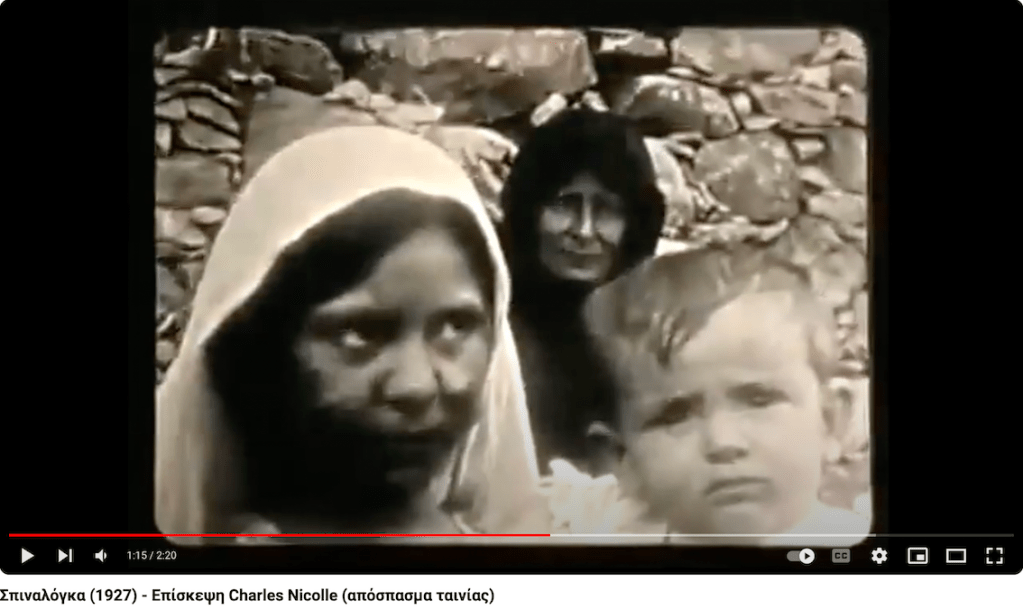
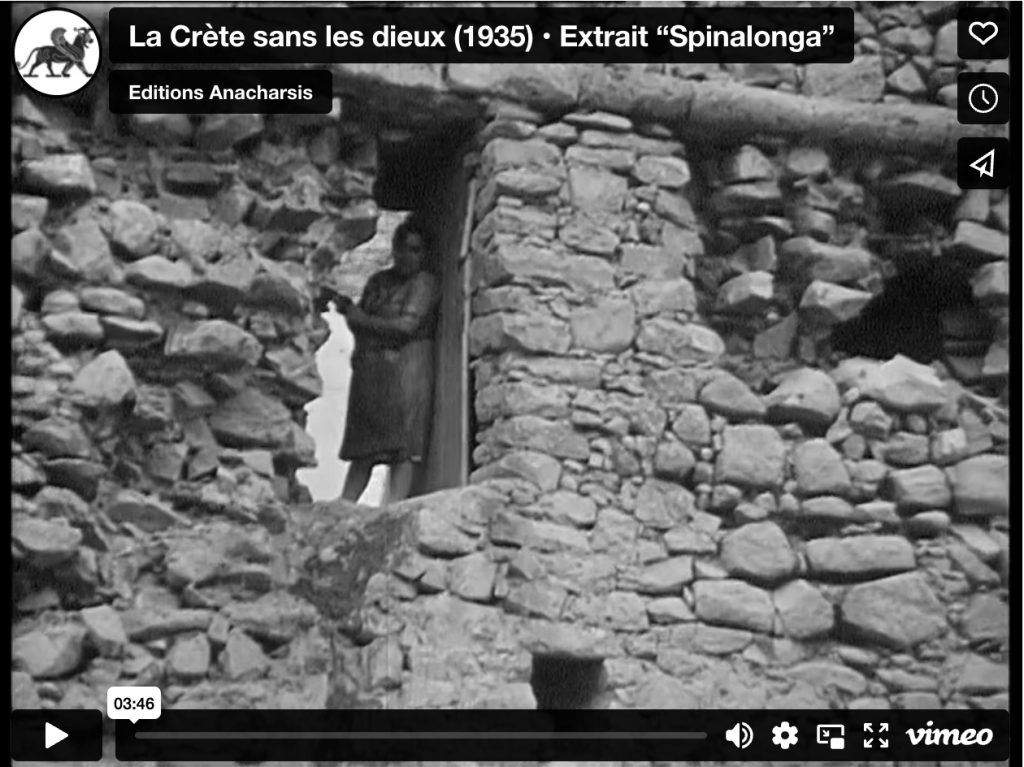
« Crete without gods » (1935), Roger Leenhardt & René Zaber ©Les films du Compas
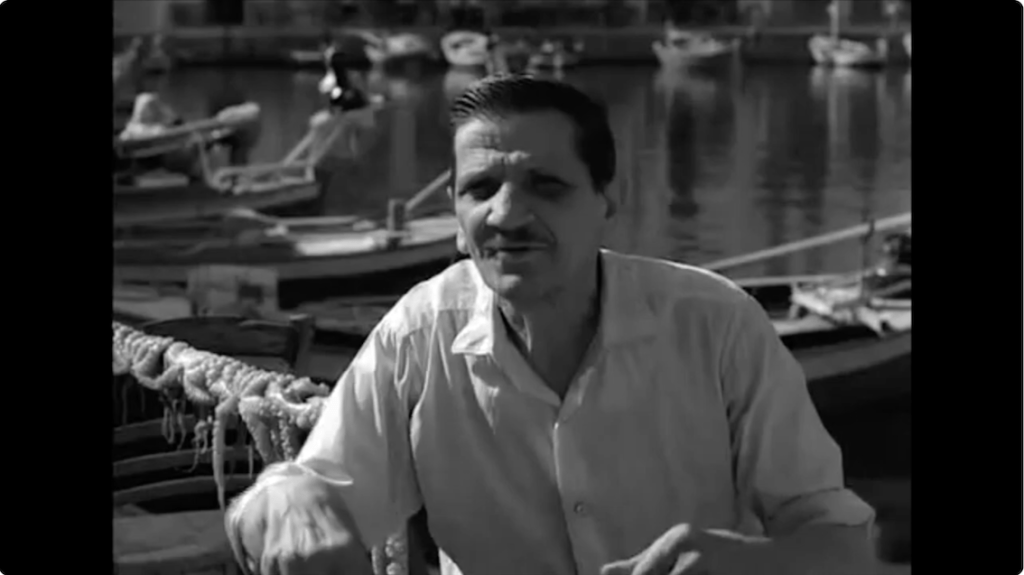
« The Last Word » (1968), Werner Herzog ©Werner Herzog
For french readers :
« Vies et morts d’un Crétois lépreux », Epaminodas Remoundakis, Traduit du grec par Maurice Born et Marianne Gabriel, suivi de « Archéologie d’une arrogance » par Maurice Born, 2015, Anarchasis éditions :
 collectifmasi.com